Robotic-Assisted Knee Replacement: What It Is & Who It Helps

Quick answer
Robotic-assisted knee replacement uses a CT- or scan-based 3D plan and a computer-guided instrument to help the surgeon position and align the implant very precisely and protect the surrounding soft tissues. The surgeon remains in control throughout — the robot is a precision tool, not an automated operator. It is one option within knee replacement; the decision to have surgery at all follows the same careful assessment as any knee replacement. At VinayakM in Greater Kailash-1, robotic-assisted techniques are offered where they add genuine value for your knee.
Last reviewed:
July 5, 2026
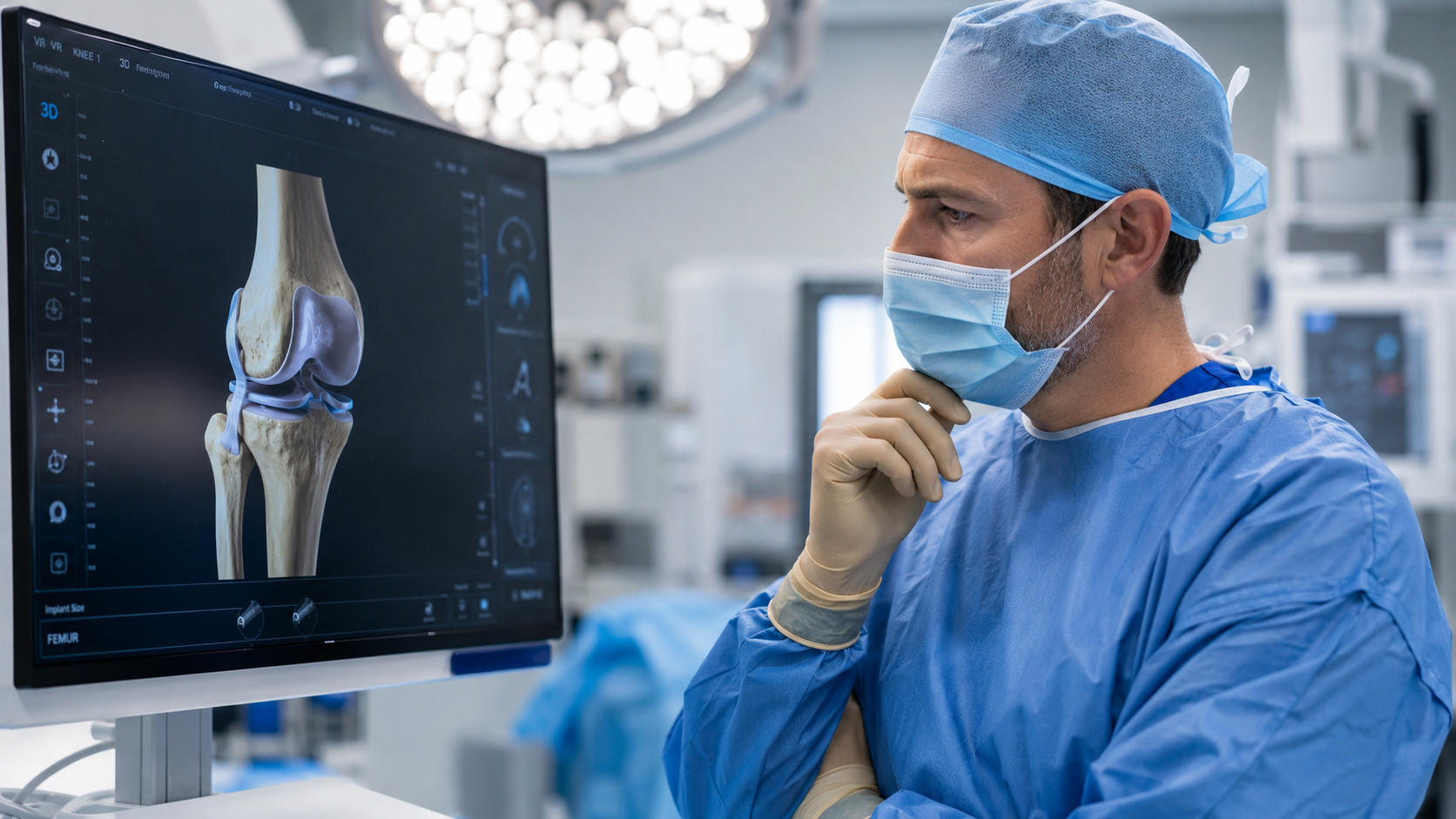
An orthopaedic surgeon reviewing a 3D knee replacement plan on a screen in theatre.

Overview

In a knee replacement, worn joint surfaces are resurfaced with metal and plastic components. How well the knee feels and functions afterwards depends heavily on how accurately those components are positioned and balanced against the individual knee's shape and ligaments. Robotic-assisted knee replacement is a technology that helps the surgeon achieve that accuracy.

The surgeon plans the operation in 3D — often from a pre-operative CT scan — mapping the implant size and position to your anatomy. During surgery, a robotic-arm or handheld guided instrument keeps bone preparation within that plan and helps balance the soft tissues. Crucially, the surgeon performs the operation and makes every decision; the system provides real-time information and constrains the cut to the plan. It is best thought of as a highly accurate guide, not an autopilot.

Robotic assistance changes how precisely a knee replacement is done — it does not change whether you need one. That decision is separate; see do you need a knee replacement?

Diagram showing a 3D pre-operative plan mapping knee replacement implant position and alignment to a patient's anatomy.

Symptoms & signs

This is a procedure rather than a condition, so there are no symptoms of its own. The relevant question is who is a candidate — and that is anyone for whom a knee replacement is already appropriate, namely people with advanced arthritis whose daily life is limited despite good non-surgical treatment (see knee osteoarthritis and do you need a knee replacement?).

Robotic assistance can be used for both partial (single-compartment) and total knee replacement. Whether it adds value in your specific case — for example, in complex alignment or when fine soft-tissue balancing is important — is part of the pre-operative discussion.

Causes & risk factors

The underlying reason for the operation is the same as any knee replacement: structural joint damage, most often advanced osteoarthritis, sometimes inflammatory or post-traumatic arthritis, that is no longer controlled by non-surgical care. Robotic assistance does not treat a different disease — it is a way of carrying out the same resurfacing operation with computer-guided precision.

The rationale for using it is mechanical: small errors in implant alignment and soft-tissue balance can contribute to residual pain, stiffness or earlier wear. By planning in 3D and executing to that plan, robotic assistance aims to reduce those errors and tailor the fit to the individual knee.

When to see a doctor

Since robotic assistance applies only when a knee replacement is already being considered, the guidance mirrors that decision. Seek an orthopaedic assessment if arthritis pain is limiting your life despite full non-surgical treatment. Seek prompt care, separately, for red-flag problems that are not routine arthritis:

  • A hot, red, swollen knee with fever — possible infection.
  • Sudden inability to bear weight or a deformed knee after injury.
  • Rapidly worsening pain or swelling.

These need attention in their own right before any planned surgery.

How it's diagnosed

Preparing for a robotic-assisted knee replacement at VinayakM involves the same thorough work-up as any knee replacement, plus the imaging the technology needs:

  1. Confirming surgery is right for you — reviewing that non-surgical care has been genuinely tried, and that your symptoms and X-rays justify replacement.
  2. 3D planning imaging — often a CT scan of the leg, used to build the patient-specific surgical plan (implant size, position and alignment).
  3. Examination and alignment assessment — range of movement, stability, deformity and the state of the ligaments.
  4. General health and fitness check — for anaesthesia and recovery, including optimising conditions such as diabetes and blood pressure.

The plan generated is reviewed by the surgeon and can be adjusted during the operation using the system's real-time feedback.

Treatment options

What happens during a robotic-assisted knee replacement:

  1. The 3D surgical plan is loaded and registered to your knee at the start of the operation.
  2. The surgeon uses the guided instrument to prepare the bone within the planned boundaries, protecting nearby soft tissues.
  3. Trial components are placed and the knee is balanced through its range of movement, with the system providing objective feedback; the plan is fine-tuned as needed.
  4. The final implant is fixed, and the knee is checked for movement and stability before closure.

Recovery is broadly similar to conventional knee replacement: early walking with support, a structured physiotherapy programme, and a gradual return to activities over weeks to months. Rehabilitation effort remains central to a good result regardless of the technique used.

Benefits and honest limits: robotic assistance is associated with more precise implant positioning and alignment. Whether that reliably translates into better long-term pain and function for every patient is still being studied, and results also depend heavily on the surgeon's experience and your rehabilitation. It is a valuable tool in the right hands — not a guarantee of a perfect knee, and not necessary for every case. We will tell you honestly when it adds value for your knee and when a conventional technique is equally appropriate.

How VinayakM helps

At VinayakM in Greater Kailash-1, knee replacement — robotic-assisted or conventional — is performed by Dr Udit Vinayak, a trauma, sports medicine and joint replacement surgeon. Our approach:

  • The decision to operate comes first, honestly. We confirm that non-surgical care has been exhausted before discussing any surgical technique.
  • The right tool for your knee. We explain where robotic assistance genuinely helps — for example, precise alignment and soft-tissue balancing — and where a conventional approach is equally sound, without overselling the technology.
  • A complete pathway — 3D planning, surgery, and a structured rehabilitation plan, because the result depends as much on your recovery as on the operation.
  • Realistic expectations, including recovery timelines and the fact that some aching or stiffness can persist.

Our aim is the best-fitting, best-balanced knee for you — using technology where it earns its place.
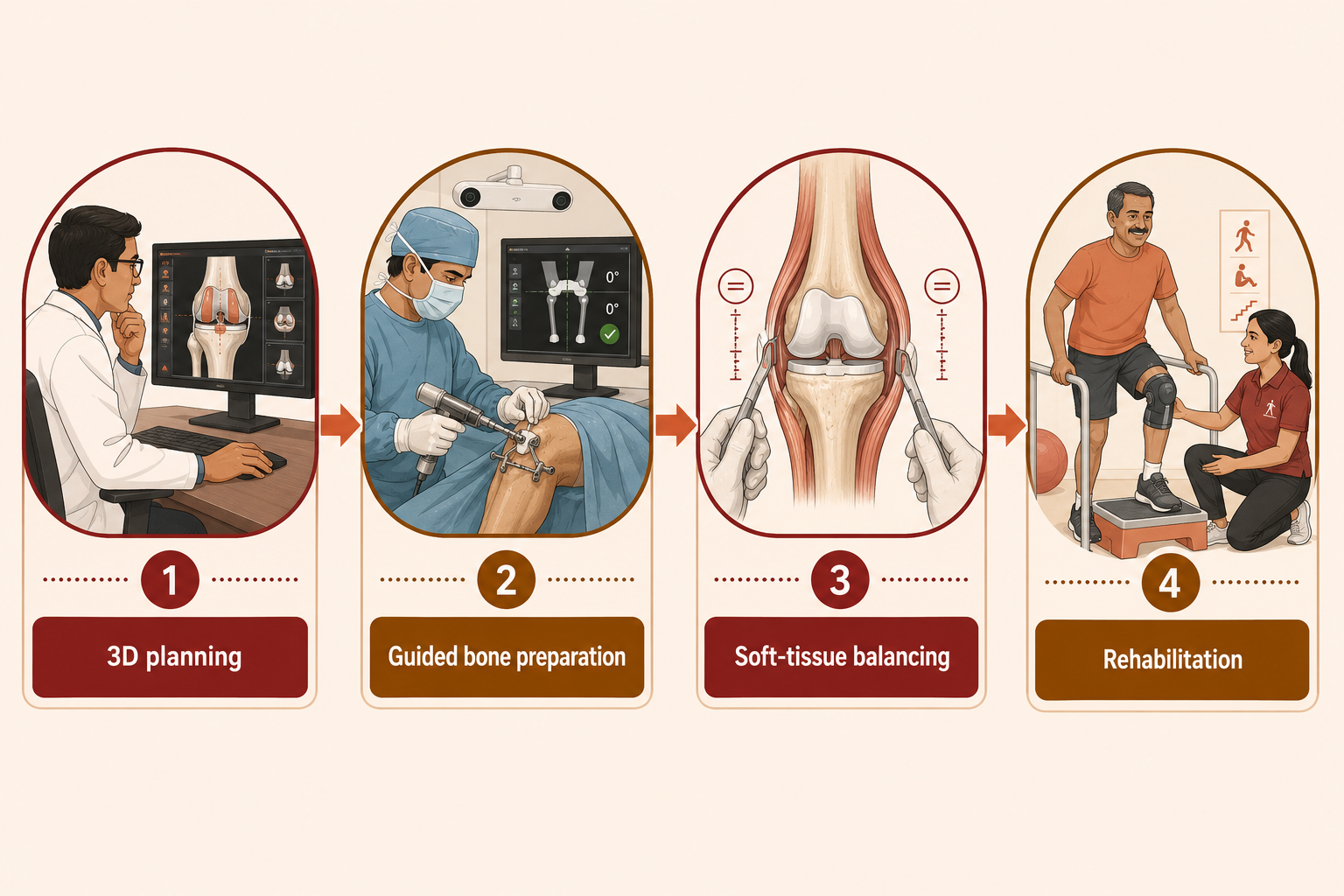
Robotic-assisted knee replacement pathway: 3D planning, guided bone preparation, soft-tissue balancing, then structured rehabilitation.

Prevention & self-care

This being a procedure, 'prevention' means two practical things: reducing the chance you will need a replacement, and preparing well if you do.
  • Delay or avoid the need by treating arthritis actively — exercise, weight management and sensible activity (see maintain knee health).
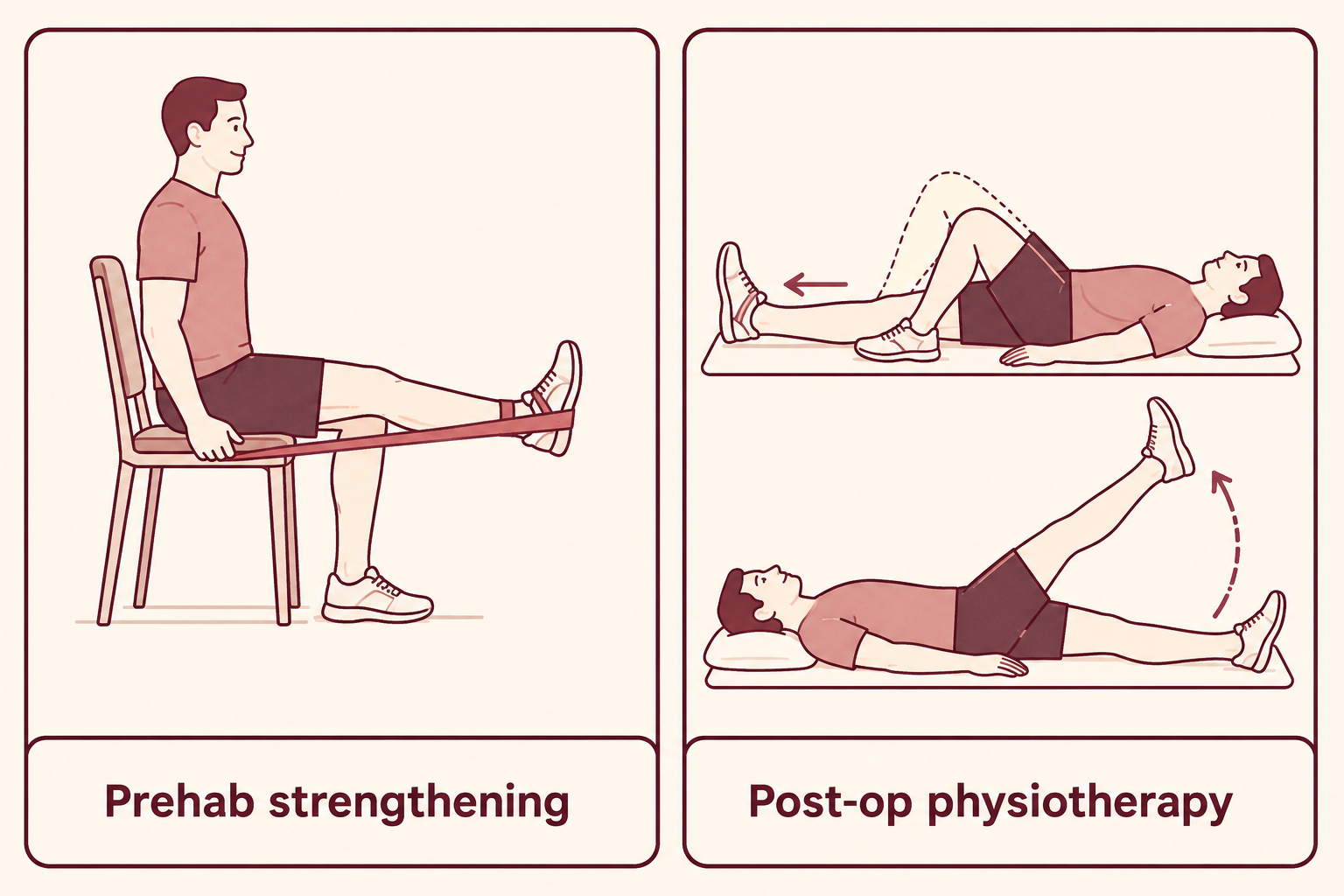
  • Prehabilitate if surgery is planned — building strength and fitness beforehand measurably improves recovery.
  • Manage weight and general health — lower surgical risk and a smoother rehabilitation.
  • Commit to rehabilitation afterwards — the technique sets the stage, but your physiotherapy determines much of the final result.
  • Ask questions — a well-informed patient who understands the plan tends to recover more confidently.
Illustration of prehabilitation and post-operative physiotherapy exercises for knee replacement recovery.

Frequently asked questions

Does a robot perform the knee replacement by itself?

No. The surgeon plans and performs the entire operation and makes every decision. The robotic system is a precision guide: it holds bone preparation to a pre-planned 3D map and gives real-time feedback on alignment and soft-tissue balance. Think of it as a highly accurate instrument, not an automated surgeon.

Is robotic-assisted knee replacement better than the conventional operation?

Robotic assistance is associated with more precise implant positioning and alignment. Whether that reliably produces better long-term pain and function for every patient is still being studied, and outcomes also depend strongly on the surgeon's experience and your rehabilitation. It is a valuable tool where it adds precision, but it is not necessary for every knee.

Is the recovery faster with robotic surgery?

Recovery is broadly similar to conventional knee replacement — early walking with support and a structured physiotherapy programme over weeks to months. Some studies suggest small early differences, but rehabilitation effort remains the main driver of your result regardless of technique. Do not expect the technology to shortcut recovery.

Do I still need a knee replacement if it can be done robotically?

Robotic assistance changes how the operation is done, not whether you need it. The decision to have a knee replacement follows the same careful assessment for everyone: significant arthritis limiting daily life despite full non-surgical treatment. See our page on deciding about knee replacement.

Can partial knee replacements be done with the robot too?

Yes. Robotic assistance can be used for both partial (single-compartment) and total knee replacement. In partial replacement, precise positioning is particularly important, which is one situation where the technology can be especially useful. Suitability depends on your specific knee.


Related reading

References

  1. American Academy of Orthopaedic Surgeons — OrthoInfo. Total knee replacement. — https://orthoinfo.aaos.org/en/treatment/total-knee-replacement/
  2. National Institute for Health and Care Excellence (NICE). Osteoarthritis in over 16s: diagnosis and management. NICE guideline NG226. — https://www.nice.org.uk/guidance/ng226
  3. National Health Service (NHS). Knee replacement. — https://www.nhs.uk/conditions/knee-replacement/
This page is for general information and education only. It is not a substitute for a consultation, diagnosis or treatment from a qualified clinician. If you have any of the red-flag symptoms above, seek medical care promptly.
{"@context":"https://schema.org","@graph":[{"@type":["MedicalClinic","LocalBusiness"],"@id":"https://www.vinayakm.in/#clinic","name":"VinayakM","url":"https://www.vinayakm.in","logo":"https://cdn.prod.website-files.com/6908cd2bb6a88638d8c0e611/6a494a210e7a3f8e0c33192a_vinayakm-name-logo.png","telephone":"+91 92171 75397","email":"info@vinayakm.in","address":{"@type":"PostalAddress","streetAddress":"3rd floor, B-23, Block B, N Block Market","addressLocality":"Greater Kailash-1, New Delhi","addressRegion":"Delhi","postalCode":"110048","addressCountry":"IN"},"geo":{"@type":"GeoCoordinates","latitude":28.556354,"longitude":77.2323718},"openingHours":["Mo-Tu 09:00-20:00","Th-Su 09:00-20:00"],"founder":{"@type":"Person","name":"Mani Sharma"},"sameAs":["https://maps.app.goo.gl/jPVPXKfH8qAUUDeo8"]},{"@type":"MedicalWebPage","@id":"https://www.vinayakm.in/orthopaedics/robotic-knee-replacement#webpage","url":"https://www.vinayakm.in/orthopaedics/robotic-knee-replacement","name":"Robotic-Assisted Knee Replacement | VinayakM","description":"Robotic-assisted knee replacement uses a 3D plan and a guided instrument to position the implant precisely. Learn how it works, its benefits and limits, and who it suits.","inLanguage":"en-IN","about":{"@type":"MedicalCondition","name":"Robotic-assisted knee replacement","alternateName":["Robotic knee replacement","Robotic-assisted total knee arthroplasty","Robotic TKA"]},"author":{"@type":"Physician","name":"Dr Udit Vinayak","jobTitle":"Trauma, Sports Medicine & Joint Replacement Surgeon","url":"https://www.vinayakm.in/team/dr-udit-vinayak","medicalSpecialty":"Orthopedic"},"reviewedBy":{"@type":"Physician","name":"Dr Udit Vinayak","jobTitle":"Trauma, Sports Medicine & Joint Replacement Surgeon","url":"https://www.vinayakm.in/team/dr-udit-vinayak","medicalSpecialty":"Orthopedic"},"lastReviewed":"2026-07-05","dateModified":"2026-07-05","publisher":{"@id":"https://www.vinayakm.in/#clinic"},"medicalAudience":{"@type":"MedicalAudience","audienceType":"Patient"}},{"@type":"FAQPage","@id":"https://www.vinayakm.in/orthopaedics/robotic-knee-replacement#faq","mainEntity":[{"@type":"Question","name":"Does a robot perform the knee replacement by itself?","acceptedAnswer":{"@type":"Answer","text":"No. The surgeon plans and performs the entire operation and makes every decision. The robotic system is a precision guide: it holds bone preparation to a pre-planned 3D map and gives real-time feedback on alignment and soft-tissue balance. Think of it as a highly accurate instrument, not an automated surgeon."}},{"@type":"Question","name":"Is robotic-assisted knee replacement better than the conventional operation?","acceptedAnswer":{"@type":"Answer","text":"Robotic assistance is associated with more precise implant positioning and alignment. Whether that reliably produces better long-term pain and function for every patient is still being studied, and outcomes also depend strongly on the surgeon's experience and your rehabilitation. It is a valuable tool where it adds precision, but it is not necessary for every knee."}},{"@type":"Question","name":"Is the recovery faster with robotic surgery?","acceptedAnswer":{"@type":"Answer","text":"Recovery is broadly similar to conventional knee replacement — early walking with support and a structured physiotherapy programme over weeks to months. Some studies suggest small early differences, but rehabilitation effort remains the main driver of your result regardless of technique. Do not expect the technology to shortcut recovery."}},{"@type":"Question","name":"Do I still need a knee replacement if it can be done robotically?","acceptedAnswer":{"@type":"Answer","text":"Robotic assistance changes how the operation is done, not whether you need it. The decision to have a knee replacement follows the same careful assessment for everyone: significant arthritis limiting daily life despite full non-surgical treatment. See our page on deciding about knee replacement."}},{"@type":"Question","name":"Can partial knee replacements be done with the robot too?","acceptedAnswer":{"@type":"Answer","text":"Yes. Robotic assistance can be used for both partial (single-compartment) and total knee replacement. In partial replacement, precise positioning is particularly important, which is one situation where the technology can be especially useful. Suitability depends on your specific knee."}}]},{"@type":"BreadcrumbList","@id":"https://www.vinayakm.in/orthopaedics/robotic-knee-replacement#breadcrumbs","itemListElement":[{"@type":"ListItem","position":1,"name":"Home","item":"https://www.vinayakm.in"},{"@type":"ListItem","position":2,"name":"Orthopaedics","item":"https://www.vinayakm.in/orthopaedics"},{"@type":"ListItem","position":3,"name":"Robotic-Assisted Knee Replacement: What It Is & Who It Helps","item":"https://www.vinayakm.in/orthopaedics/robotic-knee-replacement"}]}]}
WhatsApp